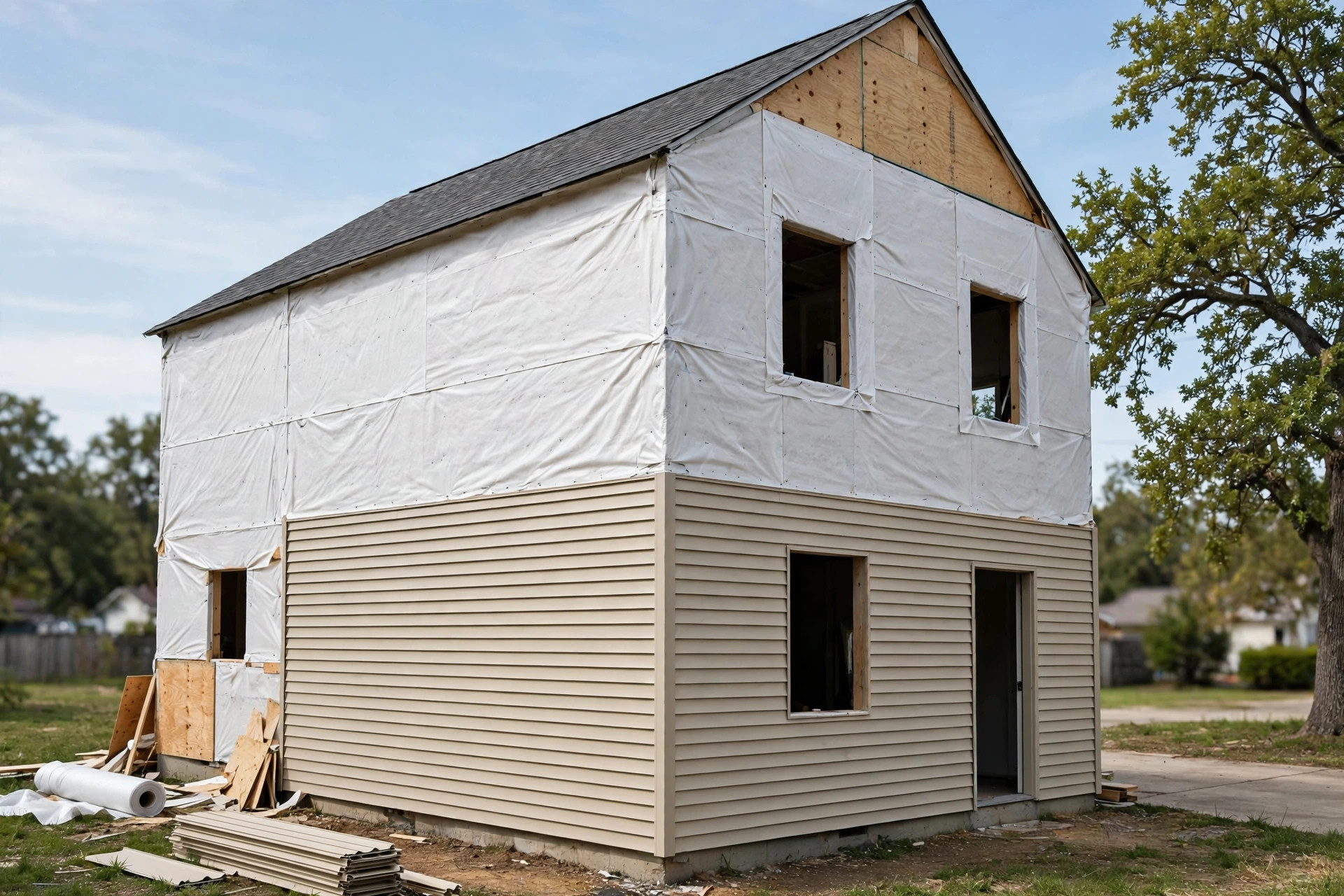
House wrap and weather barriers are protective membranes installed beneath your siding that block liquid water from reaching the sheathing while allowing trapped water vapor to escape. They form a critical second line of defense that keeps wall cavities dry and helps prevent rot, mold, and structural damage over the life of your home.
What House Wrap Actually Does
House wrap is a water-resistive barrier (often abbreviated WRB). Its job is simple but vital: stop wind-driven rain that gets past the siding from soaking into the wood sheathing, while remaining vapor-permeable so moisture inside the wall can dry outward. Most modern wraps are made from spun-bonded polyolefin fabrics engineered to shed liquid water but pass water vapor.
Think of it as a rain jacket for your house. The siding is the first layer of protection, but siding is not waterproof — water routinely gets behind it through joints, laps, and penetrations. Without a weather barrier, that water reaches the sheathing and framing, where it can cause slow, hidden damage for years before you ever see a stain indoors.
Types of Weather Barriers
Not every weather barrier looks like the familiar white wrap. Common options include:
- House wrap (spun-bonded polyolefin): lightweight, widely used, and vapor-permeable. Seams must be taped and the bottom edge properly lapped over flashing.
- Asphalt-saturated felt (building paper): the traditional choice, still common behind stucco and wood siding. Heavier and less vapor-permeable than modern wraps.
- Fluid-applied membranes: rolled or sprayed coatings that create a seamless barrier, often used on commercial projects and high-performance homes.
- Rigid foam with taped seams: exterior insulation boards whose sealed joints double as the weather barrier, adding continuous insulation at the same time.
The best choice depends on the siding type, climate, and wall assembly. What matters most is not the brand but the installation quality — lapped shingle-style so water drains down and out, sealed penetrations around windows and doors, and proper integration with flashing.
Why It Matters in Washington, DC
DC's climate puts real stress on wall assemblies. Humid summers, driving rainstorms, and freeze-thaw cycles in winter all push moisture toward your walls. Many DC homes are rowhouses with shared party walls, where a leak on one side can affect neighboring properties, making a reliable weather barrier even more important.
Older homes in neighborhoods like Capitol Hill or Georgetown may have siding installed decades ago over little more than felt paper — or nothing at all. When that siding is replaced, adding a modern weather barrier is one of the highest-value upgrades you can make, because it protects everything underneath the new siding for decades.
Signs Your Weather Barrier May Be Failing
You cannot see the barrier without removing siding, but these clues suggest water is getting where it should not:
- Interior water stains or peeling paint on exterior walls
- A musty smell near exterior walls, especially after rain
- Soft, spongy, or visibly rotted trim and sheathing discovered during repairs
- Mold growth on siding or around windows
If a contractor is already replacing sections of siding, ask them to inspect the weather barrier underneath. Repairing it while the wall is open costs far less than opening the wall twice.
Frequently Asked Questions
Is house wrap the same as a vapor barrier?
No. House wrap blocks liquid water but allows vapor to pass through, so walls can dry. A true vapor barrier blocks vapor too and is installed on the warm (interior) side of the wall in cold climates. Confusing the two can trap moisture instead of managing it.
Can new siding be installed over old house wrap?
Sometimes, if the existing barrier is intact, properly lapped, and compatible with the new siding. A contractor should inspect it once the old siding is off — torn, UV-degraded, or poorly detailed wrap should be replaced while the wall is accessible.
Does every siding type need house wrap?
Building codes generally require a water-resistive barrier behind most siding types. Some assemblies, such as foam sheathing with taped seams, serve as the barrier themselves. Your contractor should confirm the approach meets local requirements.
How long does house wrap last?
Protected behind siding and shielded from UV exposure, quality house wrap typically lasts as long as the siding covering it. Damage usually comes from poor installation, tears during construction, or prolonged sun exposure before the siding goes up.
If you are planning a siding project, make sure the weather barrier gets proper attention — it is the layer that protects your home when siding alone is not enough. Washington DC Siding Pros connects homeowners with local siding contractors who understand proper moisture management. Call (206) 360-4969 to get connected with a local pro today.
Ready to Talk Siding?
Call (206) 360-4969 and get connected with a local Washington, DC siding contractor today.
☎ (206) 360-4969