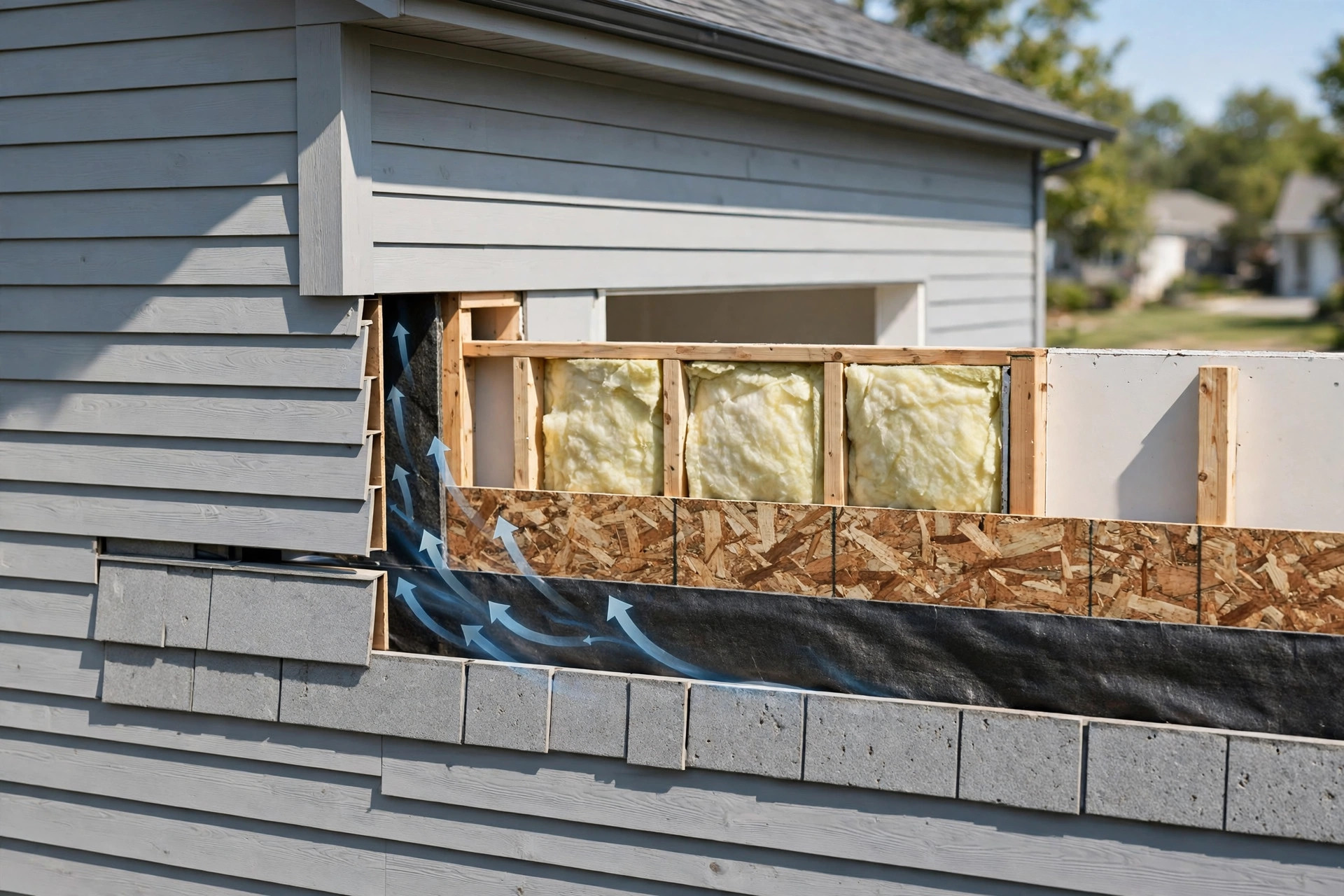
Siding ventilation is the controlled airflow behind and around your exterior cladding that lets trapped moisture escape and keeps the wall assembly dry. Without it, water that gets behind siding lingers against the sheathing, leading to rot, mold growth, and premature paint or siding failure.
How Moisture Gets Behind Siding
No siding installation is perfectly watertight. Wind-driven rain pushes water through joints and laps, condensation can form on the back of cladding during temperature swings, and small gaps around windows, doors, and penetrations all admit moisture. This is normal and expected — which is why wall assemblies are designed to manage water, not just block it.
Ventilation provides the drying mechanism. Air moving through the cavity behind the siding carries moisture away and equalizes pressure, so less water is driven inward during storms. A vented air gap also lets the back of the siding dry, which is especially important for wood-based cladding.
The Rainscreen Principle
Modern best practice often follows the rainscreen principle: an air space (typically around three-quarters of an inch) between the siding and the weather barrier, open at the bottom and vented at the top. Rain that penetrates the cladding drains down the back side and out, while airflow dries any residual moisture.
You do not always need a full rainscreen retrofit. Many siding systems — including most vinyl installations — are inherently back-vented because the panels do not sit flat against the wall. But tight, face-sealed installations of stucco or wood siding over older homes are where ventilation problems most often appear.
Why DC Homes Need It
Washington, DC's humid summers are the real test. Warm, moisture-laden air condenses readily on cooler surfaces inside wall cavities, and long stretches of high humidity slow natural drying. Add winter freeze-thaw cycles that force water into tiny cracks, and DC walls face moisture pressure in every season.
Historic rowhouses deserve extra attention. Many were built long before modern weather barriers, and their masonry or wood walls were designed to breathe in ways that modern sealed assemblies do not. A contractor experienced with older DC housing stock can recommend ventilation strategies that respect how these buildings were meant to perform.
Warning Signs of Poor Ventilation
- Blistering or peeling paint on wood siding
- Musty odors near exterior walls after rain
- Visible mold or mildew on siding that returns quickly after cleaning
- Warped, buckled, or cupped siding boards
- Soft or rotted sheathing discovered during repairs
Attic ventilation matters too — blocked soffit vents or an under-vented attic can push warm, moist air into wall cavities from above, compounding the problem.
Frequently Asked Questions
Does vinyl siding need a vented air gap?
Vinyl siding is naturally back-vented because its profile holds it off the wall, allowing drainage and airflow. That is one reason it performs well in humid climates when installed over a proper weather barrier.
Can adding ventilation fix existing moisture damage?
Ventilation helps walls dry going forward, but it cannot reverse rot that has already occurred. Damaged sheathing or framing must be repaired first, then ventilation improvements protect the repair.
Will ventilation make my home drafty?
No. Siding ventilation happens outside the air barrier of your home — it dries the wall cavity without letting outside air into your living space. Interior comfort is governed by insulation and air sealing, not cladding ventilation.
Should I ask my contractor about ventilation?
Yes. Ask how the proposed assembly handles water that gets behind the siding and how it will dry. A knowledgeable contractor should be able to explain the drainage and drying strategy in plain language.
Good siding is only half the equation — how the wall dries is the other half. If you suspect moisture trouble behind your siding, Washington DC Siding Pros connects homeowners with local siding contractors who understand proper wall ventilation. Call (206) 360-4969 to get connected with a local pro.
Ready to Talk Siding?
Call (206) 360-4969 and get connected with a local Washington, DC siding contractor today.
☎ (206) 360-4969